
Your dream is over. Day has come.
Last night you heard the autumn rain;
This morning all that is left
Is the wind in the pines,
The wind in the pines.
— Matsukaze
In the Noh Theatre tradition, the stage itself is the site of return: the same gestures performed across centuries, in the same spaces, before the same pine-painted backdrop. The plays themselves often tells of spirits who cannot leave, drawn back to the place where something was left unfinished, unfelt, unseen. The stage holds what the body could not.
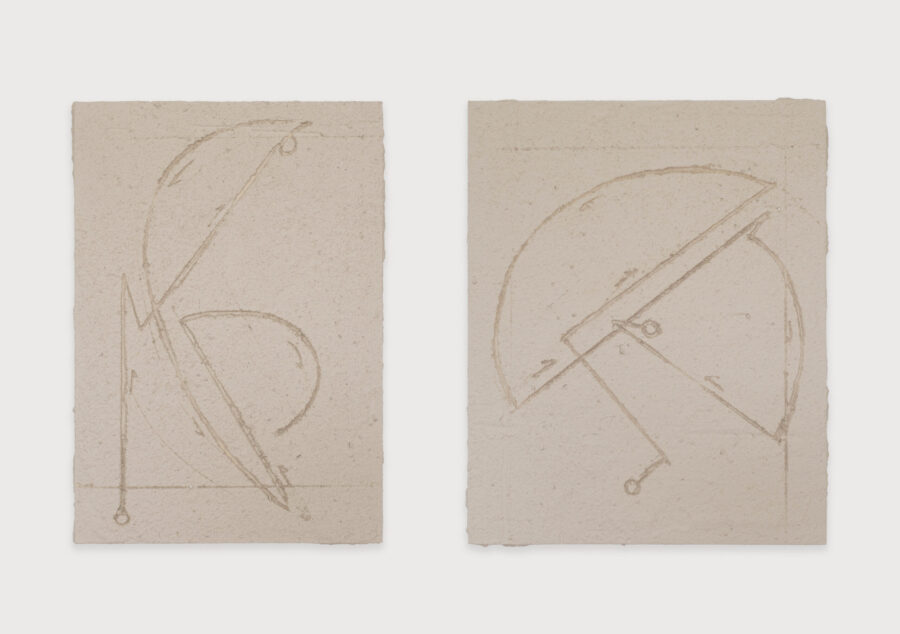
Scenes, a new series of work by Charles Munka, brings together a group of paintings that extend the visual language first developed in the Holloways series (2025), channeling movement notation systems found in Noh theatre manuals, abstracting their lines, arrows, and various symbols into charged chromatic fields.
For Scenes, Munka introduces a new material dimension to his practice with pieces made using paint mixed with the same rice bran used by local communities to scrub and maintain the surfaces of the island’s ancient Noh stages. Into this ground, worked at the precise moment before the mix fully dries, he traces single lines selected from Noh manuals: one unbroken gesture, unrepeated and unrevised. Time and texture are integral to the process; the drying surface determines what is possible and what is lost. The result simultaneously record and residue, notation and dissolution.
Running through all the works is a common line or thread, a preoccupation with paths worn into matter by time, with the way movement accumulates in surfaces rather than passing through them. Whether built through repetition or arrived at in a single gesture, what remains is always a surface that has been asked to remember.
Sado Island is home to approximately thirty surviving Noh stages, the largest concentration anywhere in Japan, and a legacy of the island’s long history as a place of exile, devotion, and cultural transmission. Many of these stages are now maintained by ageing local communities with diminishing resources. A portion of proceeds from the sale of works in Scenes will be donated directly to these communities in support of ongoing stage preservation.
Charles Munka has lived and worked on Sado Island since 2018. His practice draws on the visual systems, spatial logics, and material culture of the island’s Noh tradition, transforming them into paintings that resist fixed interpretation. Scenes is his third exhibition to emerge from sustained engagement with Sado’s stages and their communities.